Tuesday, April 26, 2011

Film Costume: Heathers (1989)

By Chelsea Turner


Heather Chandler’s costume of a power shoulder blazer, red shorts over white tights, crisp white blouse with broach closure and her iconic red scrunchie are iconic in this movie. The first time we see Heather at her ruling ground of Westerburg High in her powerful clique. Her on trend (at the time) and loud jacket communicate her authority and influence, not only over the less loudly dressed students but also over the other 2 Heathers and Veronica. The traditionally business plaid and double breasted style are also reminiscent of a forceful business man. Her red scrunchie and skirt is the symbol of her leadership status, as she states during a croquet match later that day, “I’m always red.” Later in the film, Heather Duke takes the same red schunchie and wears it, making the statement that she is now the most powerful Heather.


Film Costume: Cleopatra (1963)

By Isabella Aballi


Probably one of the most influential costumes ever to be placed in a film is Elizabeth Taylor's, Cleopatra. The historical epic directed by Joseph L. Mankiewicz and released in 1963 gave way to an iconic costume that would influence fashion for the many years to come. What is so influential about Elizabeth Taylor's representation of the Roman queen after Caesar's reign is that is affects not only fashion in the clothing sense but also in the category of accessories and makeup. There is no doubt that Egyptian inspired snake rings and arms cuffs are all in response to the costume that was presented in this 1963 epic.

The gold jewelry and long maxi dresses with embelishments are still seen today in fashion igniting the image of an Egyptian woman (Cleopatra) or Roman goddess. The last element of Cleopatra's influence is the eye makeup. When women buy eye liner and mascara and eye shadows, the aim is to give the illusion of large rounded eyes which are a key aspect of Cleopatra's beauty. The long cat eyed lining around the eyes is a famous image that follows Cleopatra and is instantly ignited in woman's minds when concerned with eye makeup. Elizabeth Taylor's Cleopatra costume is probably one of the most influential costume to ever be put on screen and follows women in every aspect of fashion.


H&M Designer Collaborations

By Isabella Aballi

In studying the democratization of fashion, the emergence of high street fashion and "masstige" are current day contributors to it. There is an increasing ability to redefine the meaning and image of luxury. The fashion industry has developed the power to redefine luxury by creating a whole different branch of fashion: “new luxury.” New Luxury is what results from high fashion luxury brands extending their companies to a wider consumer base through different strategies, the most effective one being: brand collaborations (Ginman). Through the examination of H&M’s designer collaborations, it becomes clear how the fashion industry, and specifically H&M as a brand, is attempting and successfully achieving to break from the high street branch of fashion and transcending into the realm of luxury fashion during the circulation of these collections while still maintaining their previous brand image that categorizes them as either high fashion or high street fashion.
While discussing the reproduction of fashion for the masses in the way H&M does, Benjamin offers insight into the destruction of the aura. According to Benjamin once an art work is reproduced for the masses it loses its aura. However, these designer collaborations present much more than an aura to its audience. Through H&M's designer collaborations with designers like Lanvin, Karl Lagerfeld and Stella McCartney, it allows the consumer to access brands that he/she would not normally purchase whether it be foe economic reasons or disinterest and hesitation.
The reason why the designer collaborations are so successful for both H&M and the luxury brand is because the collection only happens once a year available for a limited amount of time and a designer is never repeated. The designer never fully attaches itself to the name H&M and therefore never loses the exclusive brand image that it has developed over the years. The collaboration generate attention to the brand and show its ability to appeal to the greater audience.
There is no doubt however that the major beneficiary of these collaborations is H&M. H&M is a global retailer known for its well priced fashion conscious clothing lines and when it collaborates for an annual collection with a luxury brand, the name of the brand itself is what gives H&M a temporary step up in the fashion world. Suddenly consumer that purchase products from luxury brands are willing to buy at H&M and consumers that buy at H&M on a regular basis can finally associate with luxury fashion.


The Rise of the Fashion Blogger: Actual Democratization of the Fashion Industry?

- Barbara Leung

Bryan Boy front and centre; image courtesy of fashionbombdaily.com

In the discussion of the democratization of fashion, one cannot help but immediately refer to the emergence and acceptance of bloggers in the main current of the fashion industry. Blogs, in general, simply serve as an online format to communicate and present ideas, and have been on the rise of creation since 2005, with over 80 000 created per day during that time (Cantone). This insurgence of blogs has unveiled not only a subculture, but also hierarchical disruption in information dissemination and a new level of visual vicarious consumption. All of which leads to the question as to whether or not the fashion industry has been democratized, and has it been with the aid of the fashion blog.

The discussion of subculture leads back to the early work of British media theorist Dick Hebdige. It is not so much the actual subculture that is of interest, but rather, the incorporation/recuperation of the fashion blog subculture into the hegemonic culture. Recuperated in both commodity and ideological senses, the fashion blog has become a prevalent part of the press circle. Examples recall famed blogger Bryan Grey-Yambao of Bryan Boy quickly ushered to his seat with minutes to go until the start of the AW11 Costume National show.


Example of a street-style blog, The Sartorialist; image courtesy of http://thesartorialist.com

It is not to say that the recuperation has no results or effects on society. Vicarious consumption, as proposed by Veblen in the early 20th century, has been reformed in this context so as to include the age of the Internet. Visual consumption of the more leisurely and “in-crowd’s” experiences is possible what with photos from street style and meme blogs. But it is with this new form of visual vicarious consumption that a disruption of the hierarchy of information dissemination has occurred. Where the line of communication was once clear, from designer to journalist to consumer, it is now convoluted with the addition of the blogger who openly doubles as journalist and consumer. Recalling the example of Bryan Grey-Yambao being quickly ushered to his seat, it can be noted that Taylor Tomasi-Hill of Marie Claire arrived only minutes earlier but was only shown to a standing spot.

The question of actual democratization can then be examined by taking a closer look and redefining the leisure/in-crowd. The fashion blogger can be included in the population of the higher middle class when noting slow return on investment in creating a popular online persona. Therefore, it is not a fair representation of everyone that participates in the consumerism component of the industry. But with that said, the blog platform has allowed for the participation of the average person through commenting, and the collaboration of bloggers and brands illustrates that the “more normal” person can earn a place in the industry.

The public and bloggers expressed their disappointment with retailer Zara and their use of a fellow blogger's designs on their t-shirts, which resulted in the retail chain to pull the designs from the racks; image courtesy of DailyMail.co.uk

Amongst all of these observations, perhaps it is most important to state that the democratization of fashion has not truly been achieved. Admittedly, the rise of the fashion blogger amongst the ranks of industry has proved some sort of democratization. But the voice of the more common person is yet to be heard fully. The non-blogger can participate in democratization through commenting on entries; so it is best to say that the blog serves as an intermediary, as opposed to as a symbol of democratization of the industry.

Monday, April 25, 2011

Film Costume: American Psycho (2000)

by Anne Grant

Patrick Bateman (Christian Bale), the protagonist of Mary Harron’s 2000 film adaptation of American Psycho, charmed both women and men with his lifestyle, good looks and sleek wardrobe. Bateman obsesses over his appearance, as made evident in his voice-overs throughout the film. In the iconic “raincoat scene,” Bateman slaughters his business acquaintance, Paul Allen, with an axe:

Patrick Bateman: Paul Allen has mistaken me for this dickhead Marcus Halberstram. It seems logical because Marcus also works at P&P and in fact does the same exact thing I do and he also has a penchant for Valentino suits and Oliver Peoples glasses. Marcus and I even go to the same barber, although I have a slightly better haircut.

Resolute to stay up-to-date with the latest trends and scrupulous with his presentation, Bateman embodies the consumerist 1980s Wall Street man. Though his actions are monstrous, he manages to look good—even when soaked in Allen’s blood. His wardrobe—the Valentino suit—is a classic symbol of male authority. The designer label adds further value to the symbol. Bateman, though psychotic, also seems to act independent of any higher authority. His apparel, then, reflect his self-perceived untouchable status.


Film Costume: Napoleon Dynamite (2004)

By Nicolle D'Onofrio


In the film Napoleon Dynamite, the main character Napoleon truly marches to the beat of his own drum. An unconcerned outcast, Napoleon's fashion consists of jeans and a graphic t-shirt featuring various mythological creatures. Wearing this "Vote for Pedro" t-shirt, Napoleon is standing up to the popular kids by supporting his equally outcasted friend, Pedro, in the run for class president. This t-shirt empowers Napoleon not only as a symbol of rebellion against the cool-crowd, but also as a symbol of solidarity. It is much easier for two pariah's to stand up to a bully than one, even if that bully seems to be the entire student body. Wearing this t-shirt, Napoleon shows his support for Pedro and feels empowered by this solidarity enough to do a final dance on Pedro's behalf in front of the entire student body. This costume represents the democratization of fashion by allowing even the most atypial character to express himself through fashion.

Film Costume: Do The Right Thing (1989)

by Michelle Marques


Radio Raheem is an iconic character in Spike Lee's Do The Right Thing. His character in the film is a symbol of Black pride as racial tensions continue to mount during a sweltering summer in Bed-Stuy, Brooklyn. Radio Raheem is never seen without his trademark "Bed-Stuy, Do or Die" t-shirt, "Love and Hate" four finger rings, African pendant, and oversized boom box.

Radio Raheem's t-shirt and African pendant represents his unwavering pride for his hometown of Bed-Stuy and his African roots. This pride can be seen as he acts as a revolutionary in his neighborhood by protesting the lack of Black faces on the "Wall of Fame" at Sal's Famous Pizza. In the film, Radio Raheem uses his rings as a metaphor of the continuous struggle between Love and Hate in life. His rings also reflect his own inner struggle between the love he has for his neighborhood and black heritage and the hate he feels towards the racism of Sal, an Italian-American, and his sons. Radio Raheem's look is not complete without his oversized boom box that constantly blasts "Fight the Power" by Public Enemy.

As he walks through Bed-Stuy blasting this prophetic anthem Radio Raheem is the voice of African Americans who are tired of remaining silent in the face of discrimination.

Film Costume: Atonement: The Green Dress


In the 2007 movie Atonement, each costume was carefully designed to not only embody the character’s personality, but also the period of the 1930s-1940’s in which the majority of the film takes place. The costume designer Jacqueline Durran designed all the costumes for Atonement as well as for the film Pride and Prejudice, and she was nominated for an Academy Award for both films. The most infamous costume from Atonement is the emerald green dress that Keira Knightly so elegantly wears close to the start of the film. The color, the style and the fit are all important in order to portray Keira Knigtleys character and perhaps foreshadow later changes in the film. It is important that the viewer remembers this dress, because it is the dress Cecilia Tallis wears the night her entire life changes along with the tone of the film. The emerald green color is striking, and the green and silk evoke connotations of wealth and aristocracy. One of the many theories is that the green also reflects the envy that her sister Bryony Tallis has at the start of the film. Durran also said she chose the color because green symbolizes temptation which is a major theme throughout the film, especially during the events that take place while she wears the dress. This is the last time that we see Cecilia Tallis wear a dress that is as youthful, vibrant, sexy, and elegant. It reflects the character’s transformation from a naïve “child” to a an adult. Durran states: "instead of being constructed around Keira's body, the dress skimmed her [frame] and added to a feeling of semi-nakedness." This dress further evokes the ideas of temptation, youthfulness, playfulness, and sexiness all while remaining completely elegant. The costume also reflects the time period as seen in the slim fit, low back and long train. These were all characteristics commonly seen in dresses during this period. This is an example of how one costume can reflect a wealth of information about a character and further enhance the writer and the director’s vision.

http://www.costumersguide.com/cr_atonement.shtml

Film Costume: Reno 911!: Miami (2007)

By Jenn Liu


The costume for Lieutenant Jim Dangle, designed by Mary Ann Bozek, takes a modern day police uniform and plays with the traditional codes of a policeman’s outfit to alter the connotations that usually come with that symbol of authority. The Lieutenant still holds serious symbols of authority through adornments like his badge and his accessories belt that holds weapons like his gun, however, other aspects of his uniform are changed to reflect his character. The most obvious differentiation from a traditional uniform is his pants. Opposed to the usual long trouser, he wears extremely short and tight shorts that add a blatant comedic effect on his character as well as questions his sexuality more immediately than other the characters’ would be. His shirt also has subtle differences like his rolled up sleeves, the opened collar as opposed to a fully buttoned up collar that would otherwise give his character a more stern look, and also the blue flaps on his shirt pockets that are bigger than the ones on his shoulders takes away from the shoulder area which takes away from a sense of masculinity that usually highlighting the shoulders does on an uniform. This less serious take of an officer’s uniform effectively communicates Lieutenant Jim Dangle’s character by illustrating him as a figure of authority but one that is not taken as seriously due to aspects of femininity that exude from his costume. The costume then in that sense, takes away from the character’s power. A police man is usually to be viewed as an authoritative and serious figure but his costume’s ridiculousness takes away from that instant power of authority associated with uniforms.

Case Study: DIY Fashion

by: Christine Lee
DIY FASHION

(via)

Do-it-yourself is a term used to describe artistic efforts in which participants modify and/or create something, ranging from furniture to clothing. It is said to have emerged with the rise of the punk movement in the 1970’s, in which came substantial cultural, social, and political change. The movement lead to the rise of fanzines. Stephen Duncombe describes fanzines as “little publications filled with rantings of high weirdness and exploding with chaotic design”, where producers “privilege the ethic of DIY, do-it-yourself: make your own culture and stop consuming that which is made for you.”

(via)

Another theory in which DIY emerged: DIY is also said to be linked to the Arts and Crafts movement of the 1900’s. This was an international design movement originated in England. This movement also spread to the United States and evolved as a “reaction against the impoverished state of the decorative arts and the conditions under which they were produced.” It emphasized traditional craftsmanship as well as authentic material usage. This movement also evolved as a simple cost-saving technique between the 1940’s and 1950’s.

DIY vinyl wall art

(via)

Regardless of the true origins, or multiple origins, of DIY, there is no denying that it is indeed a huge phenomenon in society, forgoing any class structures by being used in high fashion as well as in the general public.

Democratization of fashion

Democratization is the transition to a more democratic approach from an authoritarian regime. There are no rules. The authoritarian regime in this case would be the power players of the fashion industry who tell us what is in style, where to buy from, which designers are considered noteworthy, and more. Well, these authority figures are authority no more as the power belongs to the individual who now decides what he or she wants for himself or herself, through DIY fashion.

Issey Miyake is one of the most innovative clothing designers today. In the mid-90’s, an experiment he started with Dai Fujiwara, a textile engineer and designer, turned into an fashion line in 1999 called A-POC. A-POC, standing for “a piece of cloth”, requires no sewing; the thread goes into the loom and the finished product comes out of the other side. The product is not limited to clothing but extends into accessories or even furniture. “This interactive new method not only reduces leftover fabric but also permits the wearers to participate in the final step of the design of their clothing: they determine the final shape of the product”. The wearers determine the final shape of the product giving power to the individual.


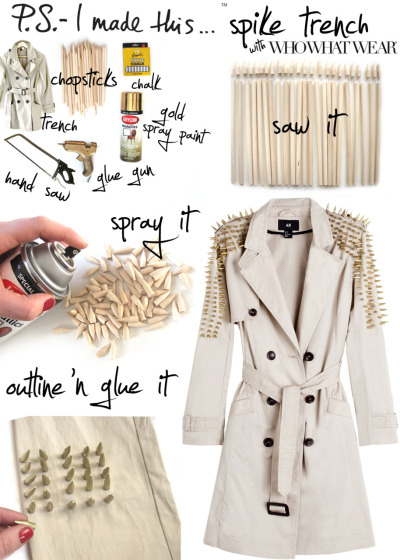
Erica Domesek is the founder, creator, and author of P.S. – I made this… a highly distinguished DIY website further showing the democratization of fashion and power to the individual. It gives readers ideas for DIY projects and even provides inspiration boards for readers to come up with their own ideas. It also has links to the best places to get materials for particular projects.

The “Art of the Trench” is a beautiful thing.  The trench  coat is quite possibly one of the most classic staples that everyone  should own.  My friends, Hillary and Katherine of  WHO WHAT WEAR, who have a new j’amazing book, “WHAT TO WEAR, WHERE”, agree that one of the most coveted pieces this spring hails from BURBERRY.   Designer, Christopher Bailey, added a new spin on the iconic trench  coat, giving us goosebumps with metallic accents to embellish.  Severe  and sexy spikes are certainly a Spring trend to steal (say that tongue  twister!) Get inspired by Burberry, and create  your own version.  Reach for lots of chopsticks (use anywhere from  50-100 pairs or more if you crave more spike-age).  Using a handsaw  (carefully) and cut down chopsticks tops.  If you don’t feel comfortable  with a saw, try heavy duty clippers.  In a well-ventilated area, spray paint the spikes, gold.  Wait till dry, flip over- and spray to cover.  Use  chalk to outline where the spikes will go.  Use droplets of hot glue on  the bottoms of the spikes, place down- and hold for a few seconds till  they set.  Remove any straggly glue hair strands, let dry- and rock it!
(via)


DIY as OPPOSITION TO FASHION - Deconstruction Fashion

Martin Margiela was a leading proponent of deconstructionism: Deconstruction itself is literally the “dismantling of clothes and embodiment of aestheticized non-functionality. He made dresses made of fabrics that did not match with the inside linings sewn on the outside bringing the “secrets” of the fashion’s “bewitching charms” to the surface. The jackets he made were also re-cut and re-sewn, details exposed.

(via)

Another major proponent of it is to take an item that already exists to serve one purpose, deconstruct it, and assign it another purpose. E2 makes customized pieces from vintage and recycled designer wear. Some of their pieces include a kimono pieced together from an old Cacharel blouse and a robe made from a number of Balenciaga scarves.

(via)

Having emerged from a rather rebellious movement, the punk movement, DIY is comparatively subdued. Although it can be considered an opposition to fashion, it is not so much against fashion as it is a manipulation of fashion codes to fit the needs of the individual. This in turn gives power to the individual who controls every aspect of what he or she wears by personal creation.

The Mad Hatter


by Sofya Gladysheva
Johnny Depp's costume in Tim Burton's Alice in Wonderland was designed by Colleen Atwood, a prominent costume designer who was won several Academy Awards, one of which was for her work on this film. The costume elaborates on the Victorian fashion code by using bright accessories and outlandish makeup. One can imagine that a hatter of those time could wear something of the sort, but it is the unruliness as well as the hair and makeup that speak to the craziness associated with the character. His contacts are bright yellow with pupils pointing in different direction. His hair is bright orange and sticking out everywhere. He has a pink handkerchief and a silly bow tie. Clearly, his appearance does not scream sanity. It is these details that point to the absurdity of his character. He has a cast on his thumb, there are various pins and needles in his hat, his hands are splotchy, and his fingernails a grimy yellow. Whereas the Disney version simply looks goofy or a little off, Johnny Depp looks stark mad, if not inhuman, which fits with the fantastical genre of the film. Atwood elucidates that this is a fantasy world where anything goes.